Four Site Archetypes Predict Recruitment Capacity. But Most Forecasts Treat Them the Same Way.
“Site archetype” tells us how many referrals to initially send to a site. How a site actually acts on its first two months of referrals tells us how to update.


At Power, where we help sites enroll against ambitious targets, getting referral volume right for each site can be deceptively hard. If we send too few, a capable site sits idle. Send too many, and referrals pile up uncalled, wasting the recruitment efforts that produced them.
But when a site first onboards with us, we lack empirical insight into their actual referral-calling capacity. To stay efficient, we set out to answer a question: Before we’ve sent a site any referrals, which traits can we use to predict its capacity to act on them?
It turns out that the strongest predictor is not the site’s therapeutic area experience, number of staff, or number of concurrent trials.
It’s the site’s operating model. Sorting sites into four operating archetypes lets us make a reasonable estimate of calling capacity on day one, with no performance data at all.
Four archetypes
Four archetypes cover most of a typical site list:
- Hospital and academic medical centers. Here, research runs alongside clinical care within a larger institution. The principal investigator is a practicing clinician first and foremost, and coordinators are frequently shared across service lines and protocols. The institutional layer of contracting, review, and scheduling moves at its own pace, regardless of how urgent an enrollment timeline feels.
- Blended medical clinic and research sites. These are standard practices that also run trials. There is a real patient panel in the building, which is a genuine sourcing advantage, but research and clinical care draw on the same staff and the same hours.
- Independent dedicated research sites. At these sites, trials are the entire focus. Staff are hired specifically to recruit, screen, and retain patients, and no clinical service line competes for their attention.
- Network affiliated research sites. The operating model of these sites matches that of the independent dedicated site, except that the location sits inside a larger organization with shared recruitment infrastructure and centralized study allocation. Individual sites often run a substantial portfolio at any given time.
A strong site list often comprises a combination of these archetypes, as they each bring their own unique benefits. Moreover, there’s substantial variance within each category (more on this later). But as a starting point, these archetypes can help us predict how a site will behave shortly after onboarding, absent additional observation.
Some archetypes are built to call. Others fit calling around the day job.
When we pulled sheer call volume across therapeutic areas and trials, we found a clear pattern mapping to archetype:
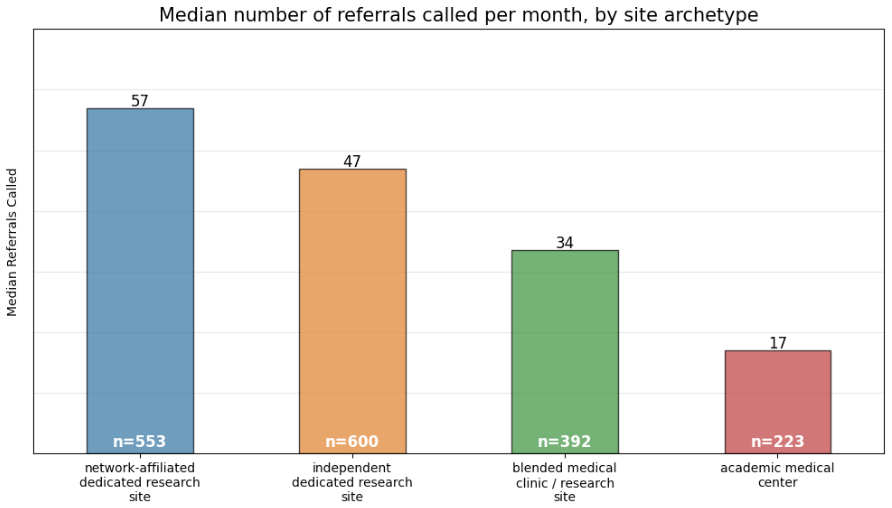
The volume differences track to the proportion of core site operations devoted to trial management. Where recruitment is the job, the calls are made more often. Where recruitment competes with something else, calling is the work that slides, because a follow up call is never the most urgent thing on any given day.
When a site first onboards, we use their archetype as a starting point for referral allocation.
- We use dynamic targeting to ensure that we recruit higher quantities of referrals in regions where our trials have the highest density of research-dedicated sites.
- Where sites have less anticipated capacity, we tighten the pre-screener on the more subjective I/E criteria, realizing that CRCs and PIs may have less time to attend to the nuances of each referral’s unique situation.
All of this said, archetype is the only signal we have before a site has worked a single referral, so it sets the starting allocation. Dynamic site support does not end at the archetype.
Archetype is not destiny
After a site’s first two months with Power, we can graduate from our coarse predictions. The capacity distributions that emerge look nothing like the tidy medians above.
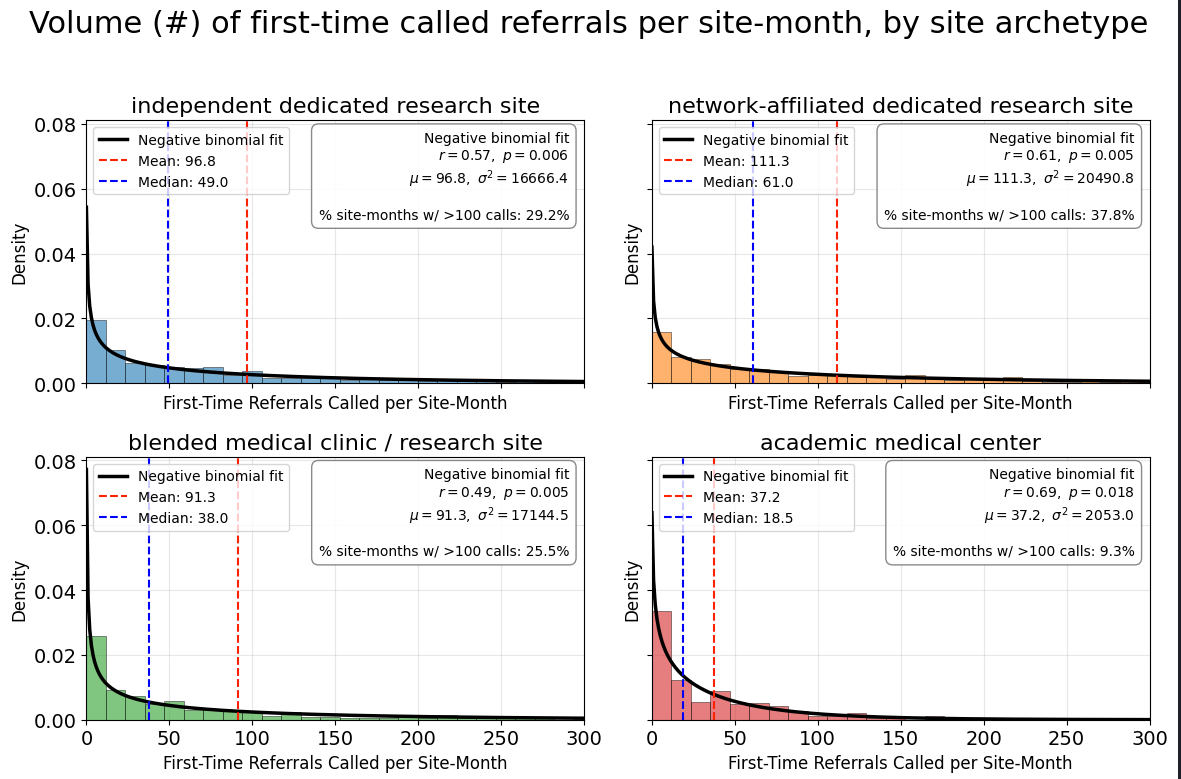
Every archetype develops a long right tail. A handful of sites in each category work far more volume than the median site in that same category, which is why the mean sits so far above the median in all four distributions.
Network-affiliated sites average 107.5 calls per month against a median of 58. Blended clinics average 88.4 against a median of 34. There are academic medical centers on our platform working more volume than the median network site. And there are dedicated research sites that have gone quiet because a coordinator left in March.
A prior is useful right up until we have real evidence, and then the evidence updates us. And when we make the update, we have several levers to even better meet each site where it is.
How we support sites across the spread
We use four mechanisms to tailor support for referral throughput to each site:
- Weekly volume reallocation. An algorithm runs every week and shifts referral volume toward the hungriest sites on the study. A site that cleared its queue last week gets more this week, while a site sitting on untouched referrals gets fewer until it catches up. The cadence matters as much as the logic, because capacity changes on the timescale of staffing and vacations rather than quarters.
- Registry building aimed at the sites that can use it. Our patient sourcing is geographically steerable, so social media campaigns and outreach to existing patients in the relevant indication get weighted toward the markets where high capacity sites operate. This is the upstream version of the same idea. Rather than simply distributing a fixed pool of patients strategically, we grow the pool where it will actually get worked.
- Eligibility matching tuned to capacity. Some referrals are clean matches and some require a real conversation, such as an apparent history of an excluded medication that may or may not disqualify the patient once a coordinator and investigator work through the details. Those judgment calls take time and clinical expertise. We route the subjective cases to sites with the bandwidth to have that conversation, and we hold constrained sites to tighter prescreening so their limited calls go to the most straightforward matches. A site with only seven calls a month should spend all seven on patients likely to screen.
- Power Dialer auto-calling tool, tuned to the use case. For sites that can put hours into the phone each day, the dialer is about throughput and clearing a large queue. But for sites working a small number of high quality referrals, it is about persistence, which means the second and third and fourth attempt actually happen rather than sitting on a list. The same tool solves opposite problems at the two ends of the distribution.
Together, these levers ensure that a constrained site is not written off and a capable site is not held back. Capacity gets met where it is, and it gets met again next week when it has moved.
However, calling referrals ≠ converting enrollments
All of this said, the measurements and levers mentioned thus far pertain to whether a site works its referral list, and that is only the first step of the funnel.
Consider the rate at which a called patient converts into a randomization for any given contracted study, downstream. Network-affiliated sites lead every calling measure we have, yet they actually convert at a much lower rate than average.
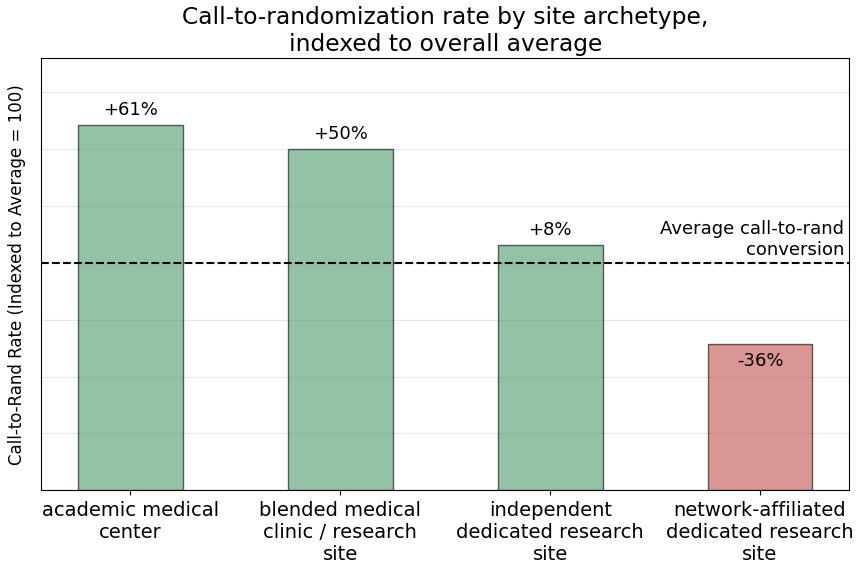
The archetype with the highest calling capacity is not the archetype converting those calls most efficiently (the gap even survives setting aside every site that never enrolled anyone at all).
Ultimately, the same portfolio depth that produced the calling advantage produces this disparity. A network site is often running many studies at once, so a patient who answers the phone may be a better fit for a different protocol on that site's list, and the coordinator will place them accordingly.
Of course, nothing about this behavior is unreasonable. It is the right thing for any given CDC to do for the patient in front of them. But it means a referral sourced for any given particular study is less likely to end in an enrollment on that study.
Thus, call capacity is a necessary input, if a poor summary. We allocate on capacity, on observed conversion, and on competing study load at the site, because a referral routed to the site most likely to call it is not always routed to the site most likely to enroll it.
Archetype gives us a starting guess, measurement corrects it. And the correction never really stops.
Power runs patient recruitment for CNS and immunology and inflammation programs, sourcing patients directly and routing them to sites based on what those sites can actually work. If you want to see how referral capacity breaks down across your own site list, we are happy to take a look. Get in touch.