How inaccurate PTSD self-reporting can screen out 15% of qualified MDD patients

It’s an exciting time in MDD research.
At Power, we’ve worked on over 50% of phase 2/3 programs in major depressive disorder (MDD) in the US in 2026 alone.
And while we often notice differences across protocols depending on the study drug’s MoA, almost all MDD protocols have a few things in common.
MDD protocols treat PTSD differently from other psychiatric comorbidities
Across the past 10 MDD protocols that have crossed our desk, all I/E criteria firmly excluded any bipolar disorder comorbidity. Likewise, all excluded any history of schizophrenia or psychosis.
But all 10 protocols treated the presence of PTSD with a bit more nuance:
- 70% of protocols only excluded PTSD if active/current in the past 1–2 years
- 30% only excluded PTSD if its symptoms were primary to those of the patient’s MDD symptoms
It makes sense to see nuance in a PTSD exclusion where bipolar and schizophrenia exclusions have none. Bipolar disorder and schizophrenia are chronic diagnoses, and often come with their own prescriptions. Unrelated psychiatric symptoms or medications could compromise signal, endpoints, and safety attribution in MDD research
But PTSD can remit, or go into the background, or “resolve” with time, therapy, or treatment.
Patient-reported PTSD history is often more nuanced than it first appears
To ensure that we appropriately capture this nuance, when MDD patients in our registry fill out their comorbidity profiles and report PTSD, we spend some extra time on the topic.
As researchers might expect, 18% of patients reporting PTSD history indicate that they do not presently have active PTSD symptoms. And 59% confirm that their residual PTSD symptoms are less prominent than their depression symptoms.
(We make sure to send the patients with qualifying PTSD history over to sites as referrals.)
But in following up on PTSD details, we find something unexpected as well.
When a patient reports active symptoms, we ask them to select which symptoms they experience, drawing from the DSM-5. For example, we ask them to confirm presence of:
- Recurrent, intrusive memories or flashbacks
- Nightmares related to the trauma
- Life-disrupting avoidance of triggers
- Connection between trauma symptoms and a specific traumatic event
But 16% of the time, the patients who report “active PTSD” don’t have these symptoms at all. Instead, they appear to have symptoms unspecific to PTSD — symptoms that are typical of anxiety, panic, or depression.
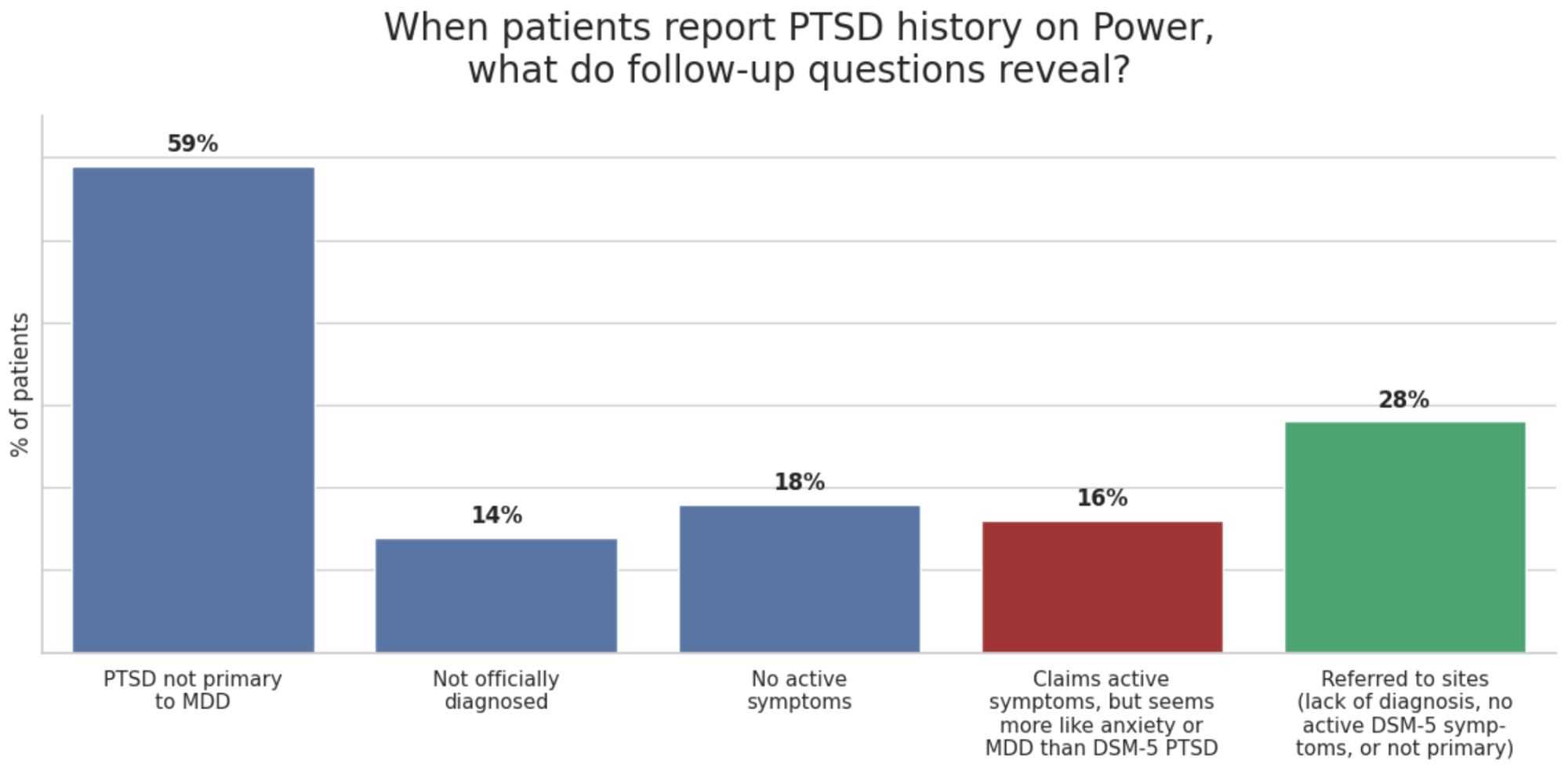
Interestingly — even officially diagnosed patients who confirm, “Yes, I have active symptoms,” sometimes don’t select any DSM-5 symptoms. Our hypothesis is that these patients have resolved PTSD, but persistent depression and/or anxiety.
These patients may continue to use the PTSD label after PTSD has resolved, because they may not realize that a decline in flashbacks, nightmares, hypervigilance, or trigger-avoidance may alter their profile. They’d need to speak to a clinician to determine whether they still meet criteria for PTSD.
Moreover, we see that 14% of patients who report PTSD share that they aren’t officially diagnosed.
We suspect that social media, ChatGPT, or other popular forms of self-help may encourage patients to adopt the label to describe problems in their mental health.
But while the patients’ mental health symptoms are serious in their own right, they alone are not sufficient for PTSD diagnosis. And critically: symptoms of anxiety or depression are not exclusions on MDD protocols!
Phone prescreening often strips that nuance away
When a patient appears unlikely to have active/current or diagnosed PTSD, we usually refer them to sites (as long as other protocol criteria are met). Given the nuance in this comorbidity and its exclusion, we prefer to give the medical monitor or PI the final say on such patients’ suitability for an MDD study.
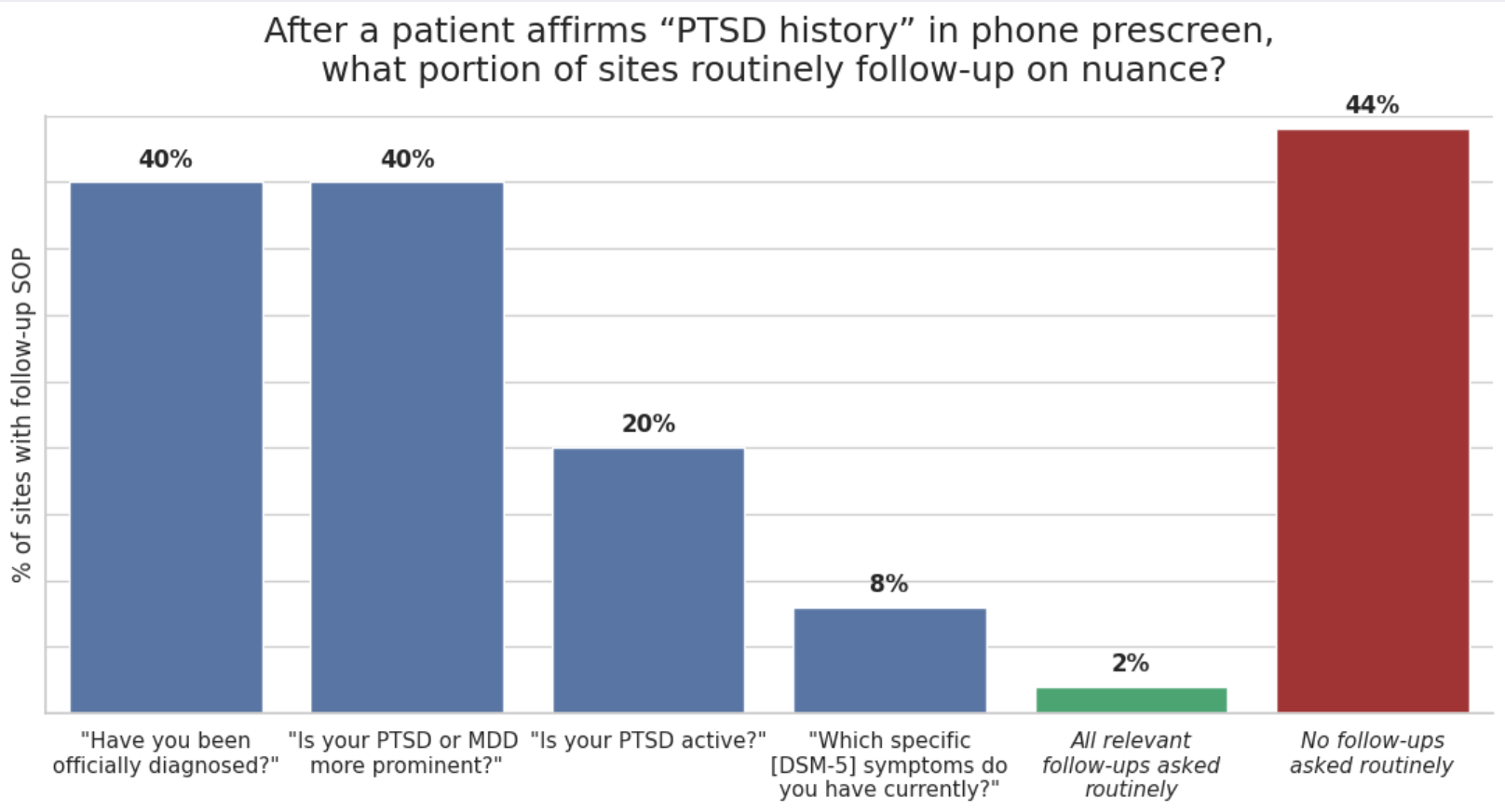
But in a recent survey of 50 CRCs across 41 sites running MDD trials, we found that standard phone prescreening practices may miss the nuance required to let qualified patients with self-reported PTSD history through.
All the CRCs we surveyed confirmed that they typically ask patients about “PTSD history” in some form during phone prescreening. This usually just shows up as, “Do you have PTSD?” or “Do you have any other psychiatric conditions beyond depression?” to start.
But very few sites have baked nuanced follow-up into their SOP when a patient answers affirmatively.
While 40% ask about official diagnosis, only 8% ask about actual, concrete symptoms.
And 44% of sites don’t follow up with any questions about the nature of the patient’s PTSD history at all. A patient simply confirming, “Yes, I have PTSD” is grounds for disqualification on the phone at said sites: no diagnosis confirmation, no active/current confirmation, no symptom confirmation, and no primary-to-MDD confirmation.
We have a few hypotheses to explain this gap:
- Pattern-matching to bipolar/schizophrenia rules. If a CRC's mental model of "psychiatric comorbidity = exclude" was built on the clean, blanket cases, PTSD may get swept into the same bucket by default.
- Default to caution to avoid medical monitor pushback. A hard "exclude on any PTSD mention" is safer than a nuanced call a CRC might get second-guessed on, so when in doubt, they screen out rather than risk passing through someone who shouldn't qualify.
- Patient misidentification of symptoms. When patients confirm, “Yes, I have PTSD,” or “Yes, my PTSD is current,” CRCs may not know to follow up about official diagnosis or the nature of their current symptoms.
That screening gap may be costing sites 15% of otherwise viable screening appointments
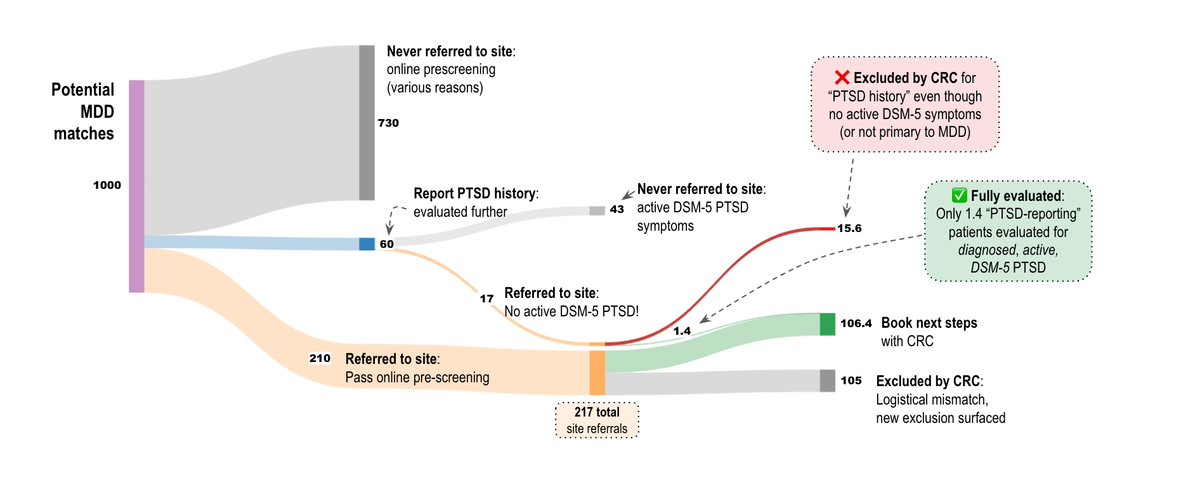
Out of every 1000 MDD patients in our registry, 773 don’t make it as referrals after we assess their history against protocols (43 of these 773 are pre-excluded for active, current PTSD symptoms or PTSD symptoms primary to depression).
While most patients we refer to sites don’t have PTSD history, the CRCs in our survey reported that — outside of PTSD exclusions — they exclude other patients about 50% of the time for other reasons: the patient isn’t willing to take on the logistical burden of study participation; there’s an issue with recent medication adherence; etc.
Of the 122 MDD patients out of the original 1000 still in the running, only an average of 106.4 patients make it to booking a screening visit appointment with the CRC.
But 15.6 are excluded for a potentially needless reason: they report a history of PTSD (even what was at one point an official diagnosis), leading to an on-the-spot exclusion — even though their PTSD is likely to be resolved (or never officially diagnosed in the first place).
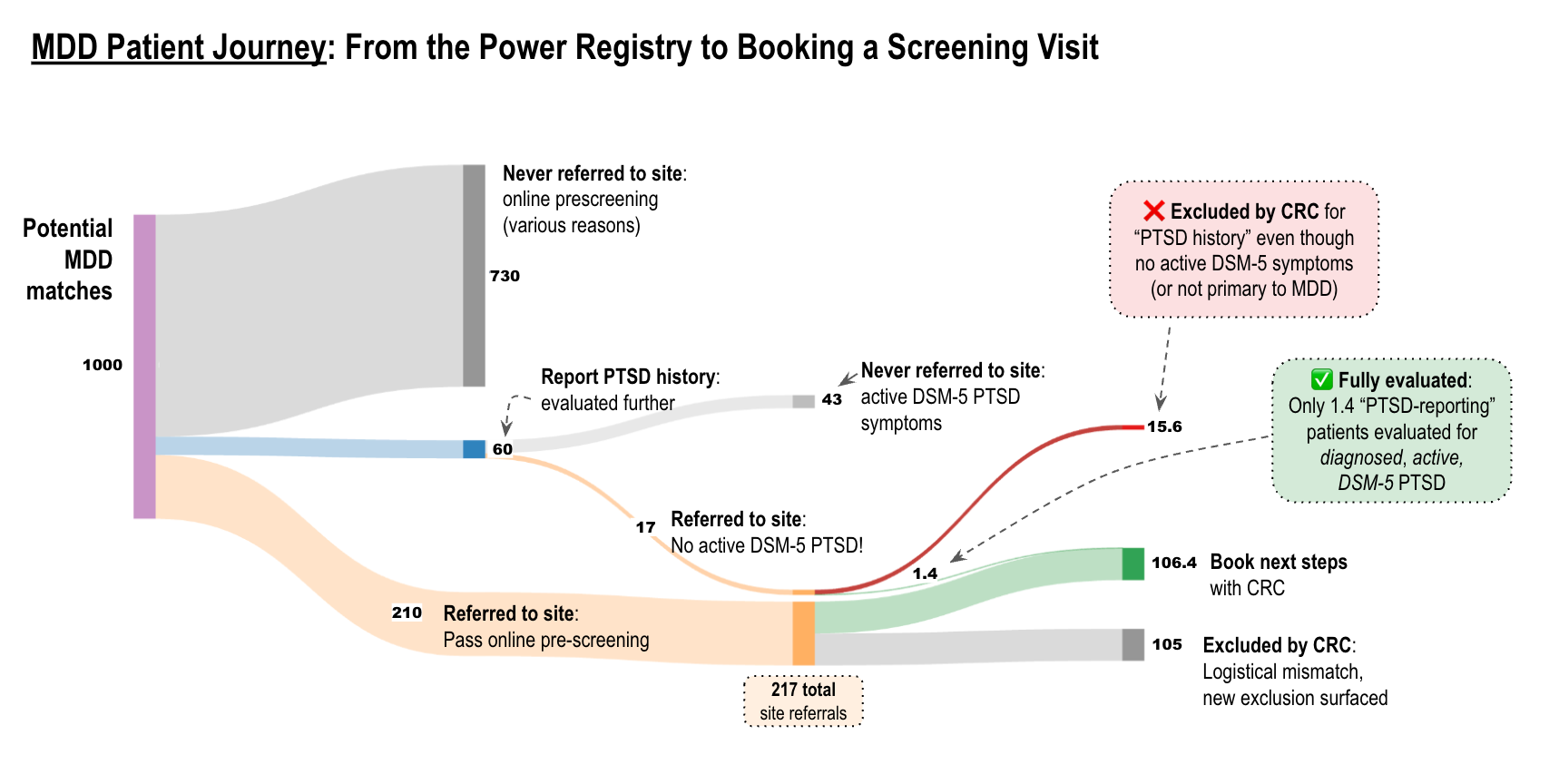
Were those 15.6 patients evaluated with more nuance, we could potentially see an increase in screening visits booked by 15.6 / 106.4 = 14.7%.
Good screening protects rigor without sacrificing fit
Here’s the balance we’re aiming for: rigorous screening should keep truly ineligible patients out without screening strong candidates out unnecessarily.
With PTSD, that means being precise enough to distinguish active, protocol-excluding disease from a past diagnosis or resolved symptoms, which the protocol allows.
We work with sites to make sure both happen. We aim to protect the study from poor-fit patients, while giving otherwise strong MDD candidates a fair path through prescreening.
Are your sites excluding the right patients — or just the easiest ones to identify?
Power runs patient recruitment for neurology and psychiatry programs, sourcing patients directly and routing them to sites based on what those sites can actually work. If you want to see how referral capacity breaks down across your own site list, we are happy to take a look. Get in touch.