The Best Window to Call a Prospective Patient Back Is the One Almost No One Uses

Imagine this: a patient finishes a prescreening form on a Tuesday morning. Twenty-five minutes later, the site calls. It's textbook speed-to-lead!
This is the site's MO: most referrals it receives receive a swift ring.
The patient doesn't pick up, though. Neither do 62% of others called that fast.
The site's speed-to-lead numbers look great. But they may only count the first call. A few hours later is when she's likeliest to pick up a second call, and this site — almost no site — calls then. (In fact, there's a 41% chance that a trial applicant never receives a callback).
We pulled two years of call data to see what sites do after a patient misses the first call. We examined 130,386 qualified referrals from trials on the Power network, from June 2024–July 2026, with the timing and outcome of every site-to-patient call in the 30 days after referral. We say that a patient is reached when a call becomes a real conversation, as opposed to a voicemail or a hang-up.
We find: while our industry's attention is on the first call, the bigger opportunity lies in the call after it.
Because sites don’t lose most otherwise-qualified patients in screening no-shows. They lose them on the phone, before screening ever comes up.
The first call matters, but most patients don't pick it up
Let's start with what our industry gets right. Call fast, and more patients pick up!
Patients called within an hour of referral picked up the first call 38% of the time. Patients called after a day did 29% of the time. This is a 30% lift from timing alone! In practice, we find that this works because a patient who just finished a on online prescreening form (often on mobile) is still holding their phone and readily recognizes why an unknown number is calling.
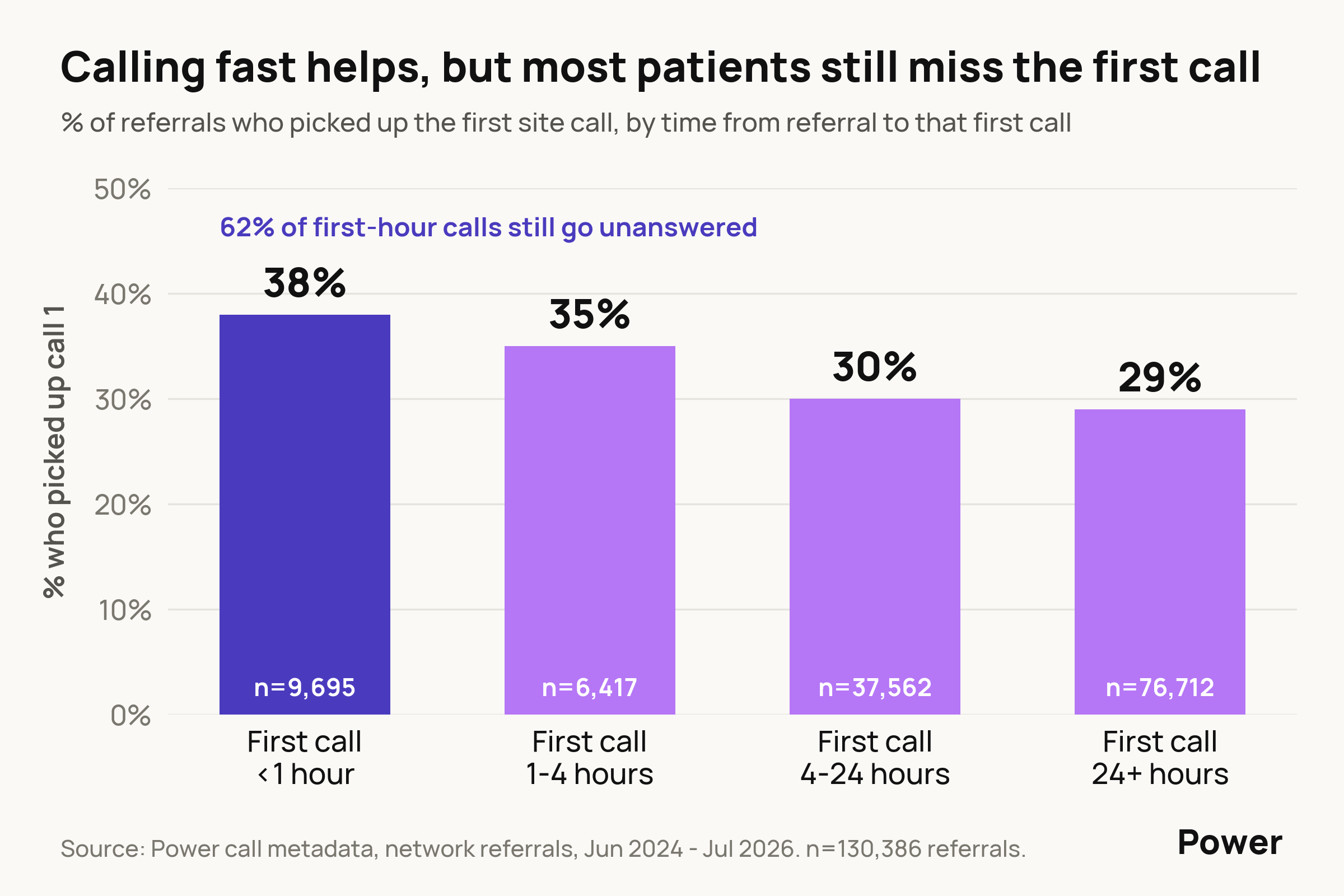
But still, if we look at the same chart from the other side, we see that even the fastest sites miss 62% of patients on the first call. Sites whose first call comes a day after referral miss 71%. For most referrals, the first call isn't where they're reached, which means that what the site does next matters.
And a second call can make up a lot of ground
The next move is simple: call again. And it works!
Of patients who missed call 1, 14–16% picked up call 2 (no matter when the first call occurred). Let's run the math for a site that dials a day after receiving the referral for call 1:
- Call 1 reaches 29% of referrals.
- Call 2 reaches about 14% of the remaining 71%, another 10 points.
- Total: 39%.
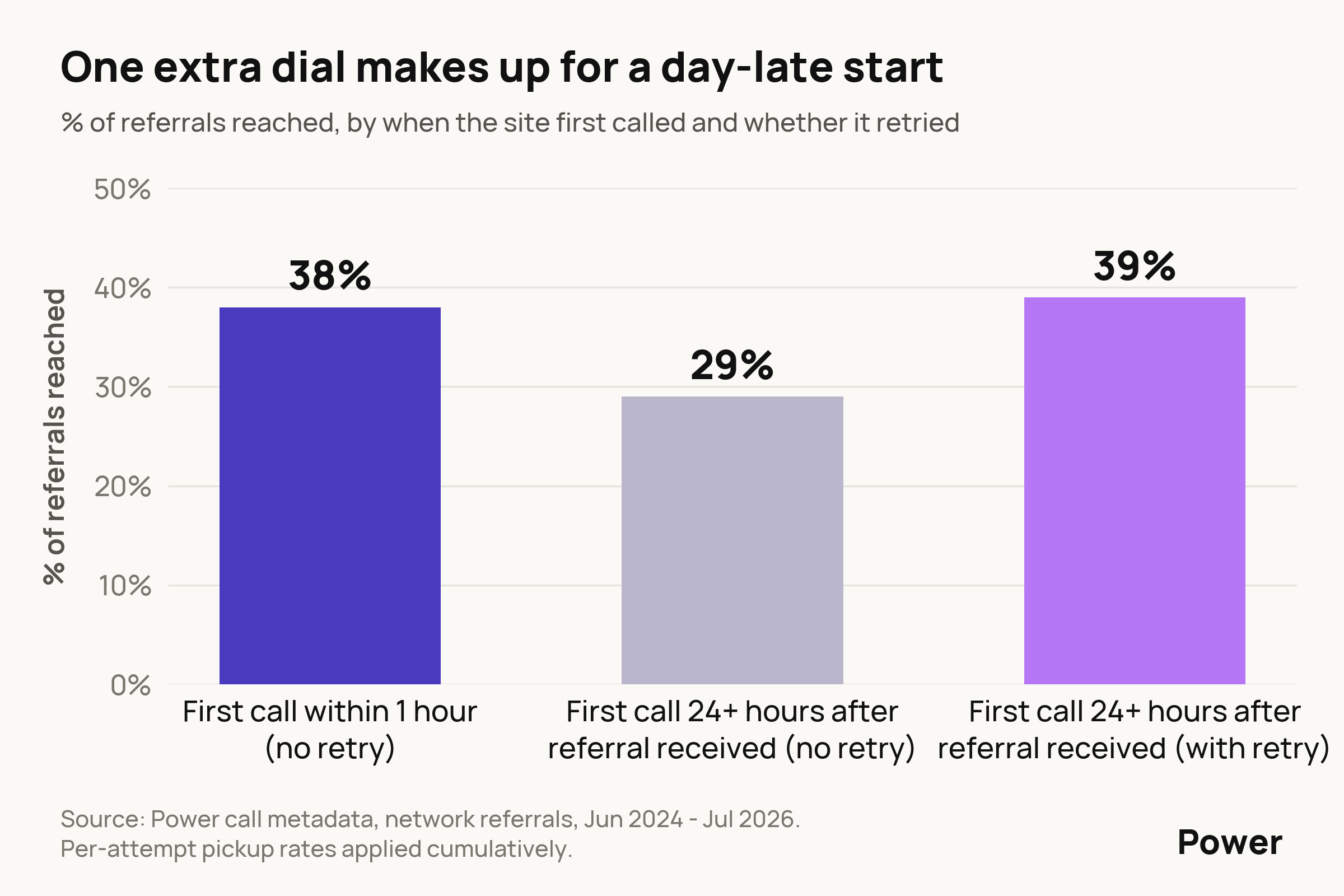
This outcome matches that of a first-hour site that stops after one call (38%). Persistence can buy back a slow start.
So the question becomes: when should that second call go out?
When you call back matters as much as whether you do
We looked at every retry after a missed first call, and how long after the miss it occurred.
Retries placed 1–4 hours after a missed call were picked up 23% of the time. That's nearly double an immediate redial (13%), and more than double a retry placed later that day or the next (10%).
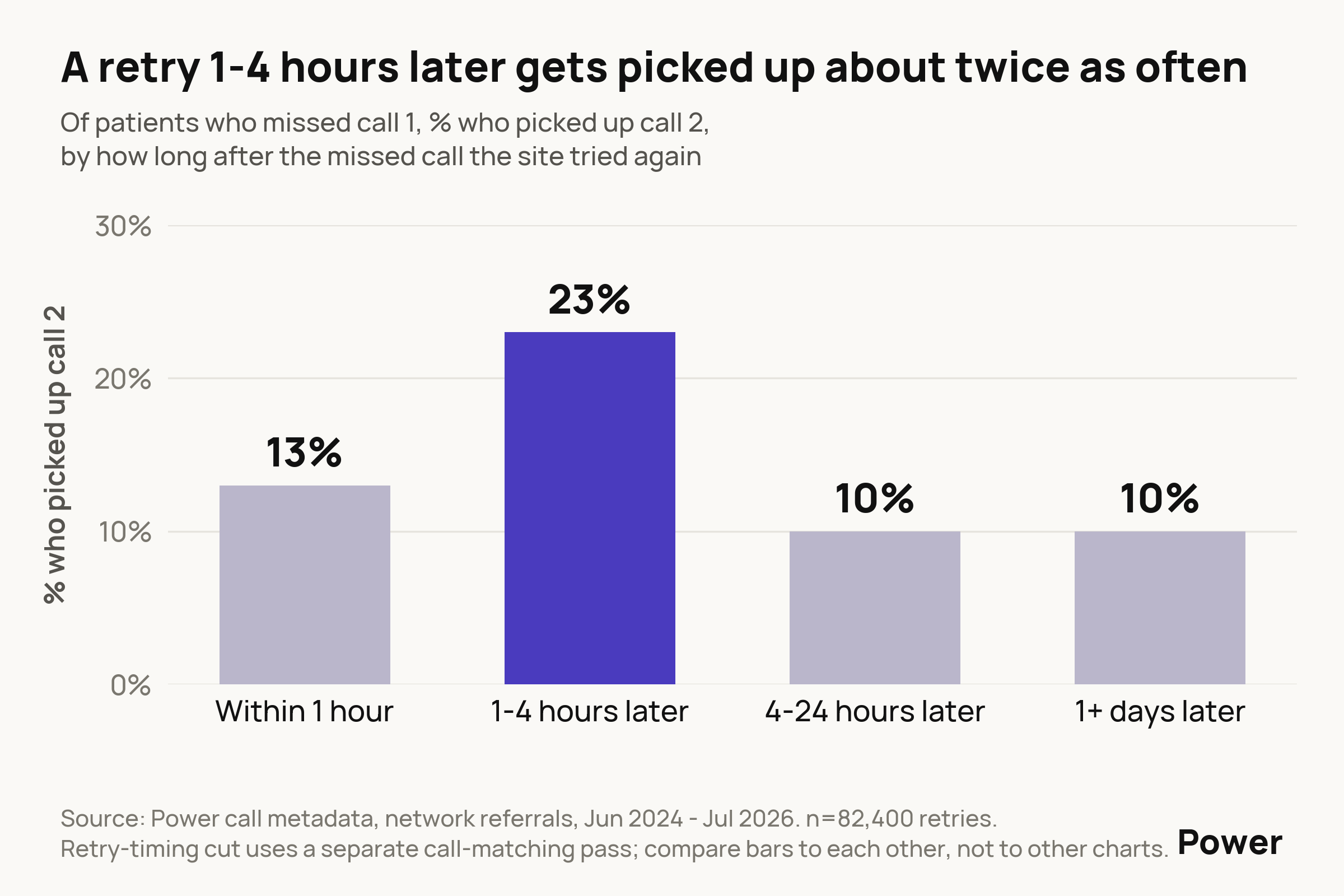
We suspect that 1–4 hours is the sweet spot because, within the hour, the patient is probably still in the meeting, the car, or the shift that kept them from answering. A few hours later, they're likely to have changed tasks. But wait until tomorrow and the moment to strike has passed.
Is the difference explained by some site feature? No, we compared window effect within the same site: retries in the 1–4 hour window were still picked up well above that site's own average. And the pattern held whether the site's first call came in an hour or a day.
Yet that's the window sites almost never use
If a retry 1–4 hours later works best, you'd expect sites to lean on it. But most don't (yet!).
In our data, only 3% of retries go out 1–4 hours after a missed call. We see that 12% are close to immediate redials (fast, but the patient is usually still busy). Meanwhile, 68% go out a day or more later... with more than a third waiting three days or longer.
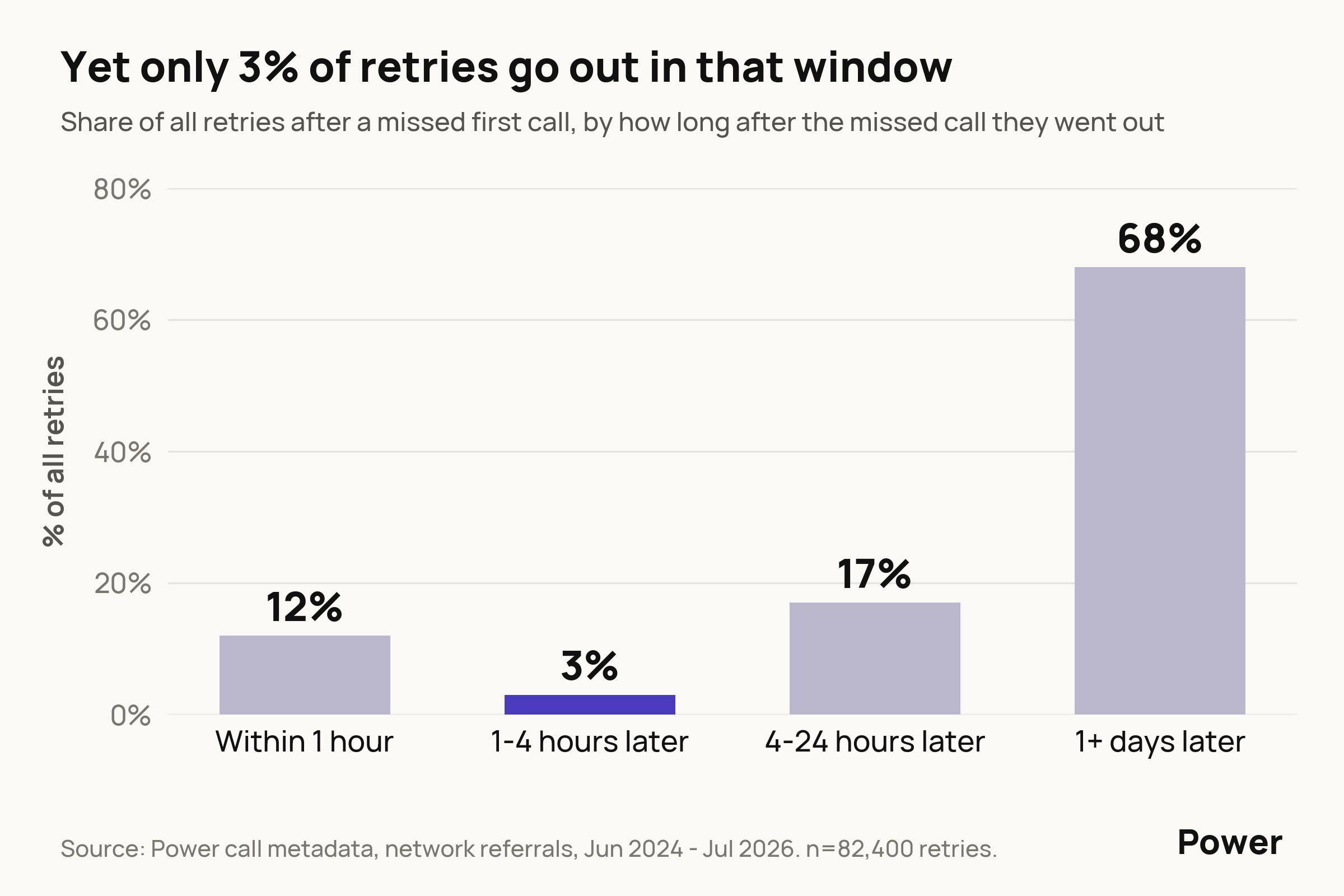
The pattern holds site by site, too. Of the 209 sites with at least 30 retries, 90% place most of their retries a day or more later, and not one puts even a quarter in the 1–4 hour window. That's not surprising: when a coordinator's day is booked with screening visits and monitor calls, a next-day callback is often the natural default.
And here, we're looking at sites that do call back. Many can't keep up: maybe between screening visits, monitor calls and new referrals coming in, a missed call slides down the list. Of patients who missed call 1, 53% never got a second attempt in the next 30 days. That rate was highest, at 58%, for sites whose first call came a day or more after referral, which are also the sites where a retry could help most.
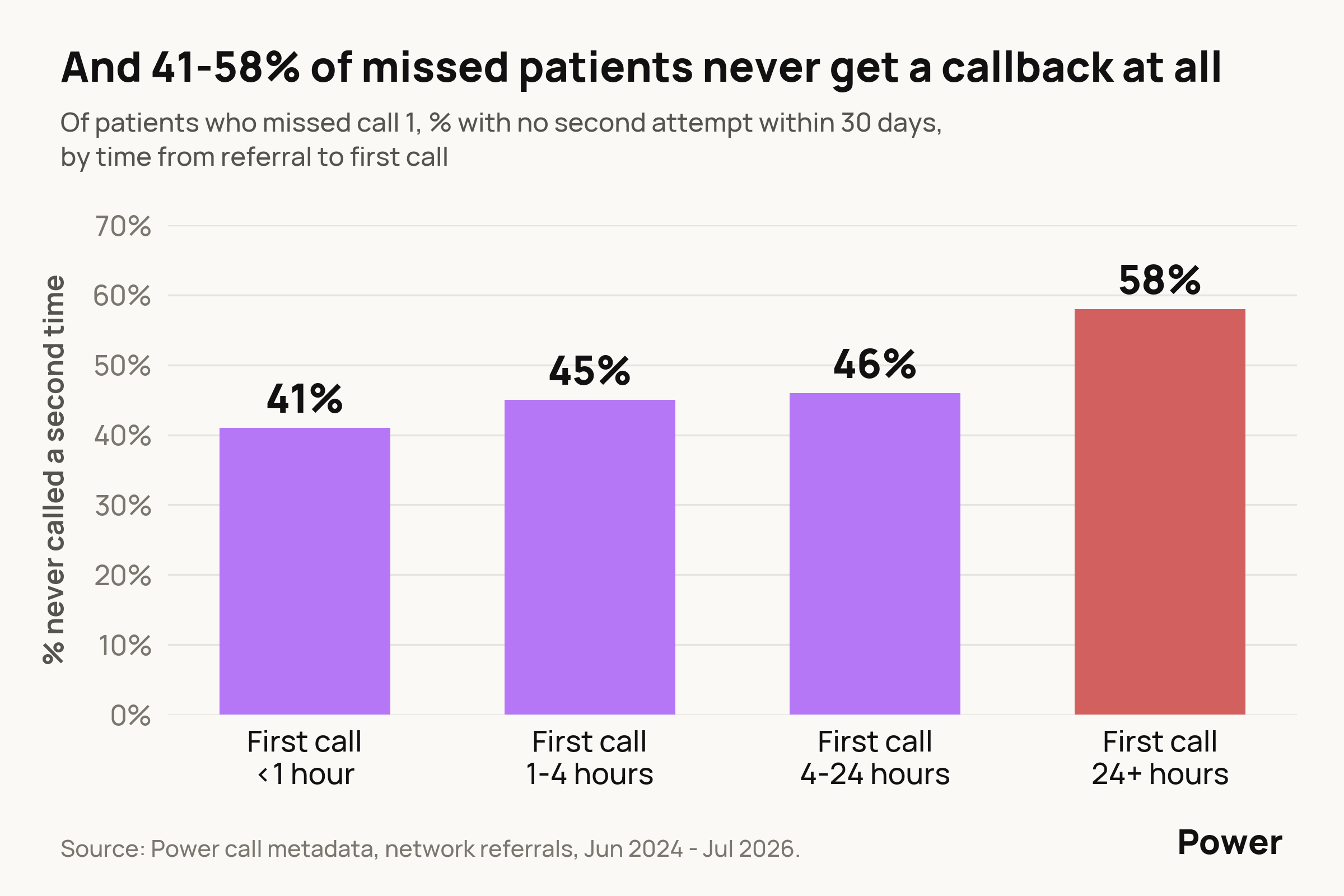
These patients, who may be qualified, just disappear from the funnel. (see: The Silent Dropout)
Our take: Build the callback into the workflow
In sum: calling fast helps, but most patients miss the first call anyway. A second call can make up much of that ground.
- Schedule a retry 1–4 hours after the first missed call. If call 1 went out at 10am, the retry should go out early afternoon. If possible, put it on the coordinator's calendar or in the dialer queue the moment call 1 misses (so it doesn't depend on anyone remembering, among their 100 other tasks).
- Protect the first hour. Route new referrals to whoever is free; put them at the top of the dialer queue; and, if possible, dedicate someone to covering referrals that land after hours (see: Human or AI Voice Agents?).
- Track referral-to-conversation time. Few dashboards track follow-up calls after the first dial — when or even whether they happened. (see: Enrollment Slipped Last Week. You'll Find Out Next Month)
What the data can't tell us yet
This is observational data, not an experiment. The within-site comparison rules out the simplest explanation — that better sites both retry faster and reach more patients — but it can't rule out every confounder. Coordinators might choose a quick retry for patients who seemed easier to reach.
The retry-timing finding also describes a rare behavior: only about 3% of retries fall in the 1-4 hour window. Our dataset contains about 2,100 retries (plenty to measure!) but the sites making them may differ in ways the data doesn't show.
A place to start
This problem doesn't need a new system or a new vendor. The conversation is about when the second call lands, which sponsors, sites and recruitment partners can work out together.
A good first conversation with your sites: when a new referral misses the first call, when does the next one usually go out? And what would make a same-afternoon retry easy to fit into a coordinator's day?
Power supports recruitment for CNS and I&I programs through our recruitment network: a million patients today, growing every month. If you want to see callback timing, follow-up gaps and pickup rates across your own site list, we're happy to take a look. Get in touch.